Echo Font: A Display Typeface That Elevates Handmade Goods
If you’ve ever spent hours tweaking a label, repositioning text on a printable planner page, or testing how a font cuts on your Cricut—only to find it lacks warmth or clarity—you’ll understand why Echo feels like a quiet revelation. It’s not just another display font. It’s the kind of typeface that makes your candle jar label look boutique-worthy, turns a simple “Thank You” sticker into something customers photograph and tag, and gives wedding welcome boards that effortless, elevated charm—without sacrificing readability.
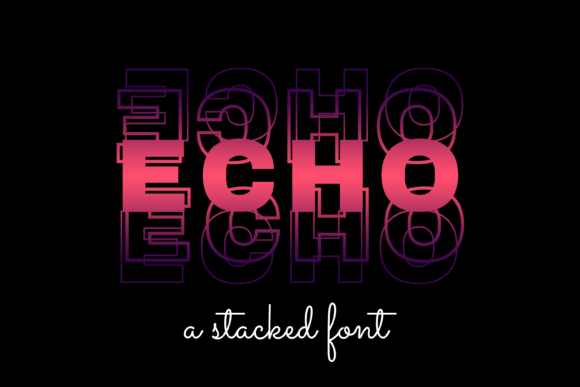
Echo is a modern display typeface with soft, confident curves and balanced letterforms. It walks the line between approachable and polished: friendly enough for a children’s birthday invitation, refined enough for artisanal soap packaging. There are no harsh angles or distracting embellishments—just clean rhythm, consistent spacing, and subtle personality in every glyph. That balance is why it works so well across physical and digital product formats, especially when legibility at small sizes matters.
Where Echo Shines in Real Craft & Product Work
I use Echo most often where first impressions count—and where the font needs to hold up under real-world conditions: printed on kraft paper tags, cut from vinyl for shop signage, scaled down to 8pt on a product sticker, or rendered crisply in a Canva template for digital download buyers.
- Handmade labels & packaging: Echo reads clearly at 10–12pt on 2” x 1” candle or bath bomb labels—even on textured paper. Its open counters and generous x-height prevent ink fill-in during printing.
- Stickers & die-cut designs: Whether I’m cutting Echo from matte vinyl for a small-batch sticker sheet or layering it in Silhouette Studio for layered acrylic signs, the strokes remain distinct and smooth. No thin hairlines that vanish at 1.5” height.
- Invitations & wedding stationery: As a primary display font for names and event details (paired with a light serif for body text), Echo adds sincerity—not stiffness. It’s equally at home on rustic farmhouse invites and minimalist modern suites.
- Digital printables: In my best-selling printable wall art bundles, Echo anchors quotes and affirmations without competing visually. Its weight holds up beautifully in PDF previews and prints cleanly on both laser and inkjet printers.
- Mugs, totes & apparel: When converted to vector paths for screen printing or heat transfer, Echo maintains integrity. I’ve used it for small-batch ceramic mugs with “Good Morning” handles and linen tote bags with centered monograms—always crisp, never pixelated.
Practical Tips for Using Echo Well
Like any strong display font, Echo isn’t meant for long paragraphs—but it excels where attention, emotion, and brand voice matter most. Think titles, headings, short phrases, names, and decorative accents. For longer text blocks (like instructions on a craft kit insert or ingredient lists), pair Echo with a clean, highly legible sans serif—think Montserrat Light or Lato Regular. That contrast creates visual hierarchy while keeping things scannable.
For script-heavy projects—say, hand-lettered-style greeting cards—I often use Echo as the bold headline (“You’re Invited”) and layer a delicate handwritten font beneath for the date and location. The pairing feels intentional, not cluttered. And because Echo avoids excessive swashes or ligatures, it stays versatile across platforms: it renders reliably in Cricut Design Space, Silhouette Studio, Adobe Illustrator, and even basic Canva text boxes.
When prepping files for production, I always check the included file formats—Echo comes in OTF and TTF, which covers nearly all cutting machines and design software. While the base character set supports English, accented characters, and standard punctuation, I recommend verifying multilingual glyphs if you serve international markets or bilingual audiences.
Why Licensing Matters—Especially for Sellers
As a small shop owner selling physical goods, digital templates, SVG files, and printable collections, I treat font licensing like ingredient sourcing: non-negotiable. Echo is a commercial font, meaning its license permits use in products you sell—whether that’s hand-stamped gift tags, editable Canva invitation templates, or heat-transfer designs for Etsy merch. Just be sure to review the specific terms: most reputable display fonts like Echo allow unlimited physical product use, but restrict embedding in editable web fonts or reselling the font file itself.
This clarity saves time and peace of mind. No second-guessing whether your holiday SVG bundle complies—or whether that “Happy Holidays” mug design falls within scope. With Echo, I know I can confidently build brand consistency across packaging, social graphics, website headers, and product mockups—all using the same trusted typeface.
A Font That Grows With Your Shop
What makes Echo more than just “pretty” is how it adapts as your business evolves. Early on, I used it only for Instagram story headers and shop banner text. Then came custom sticker sheets, then printable planners, then wholesale packaging for local boutiques. Each time, Echo held its own—not as a trend-chasing novelty, but as a reliable, expressive tool.
It doesn’t shout. It connects. Whether someone sees your Echo-powered “Small Batch • Hand-Poured” label at a farmers’ market or downloads your “Self-Care Checklist” printable at midnight, the font quietly reinforces care, intention, and craftsmanship. That’s the power of thoughtful typography—not flash, but resonance.
If your current display font feels either too stiff or too fragile for real-world making, give Echo space to breathe in your next project. Try it on a sample product label. Drop it into your next Canva template. Cut it out on scrap vinyl. You’ll feel the difference—not just in how it looks, but in how your customers respond.